

A council limits a demonstration, a hospital shares sensitive information, or a newspaper publishes details of someone’s private life. Each decision raises a question: was the interference with a protected right justified? Proportionality in UK human rights law provides a structured answer. The issue is not simply whether an authority had a good reason to act, but whether its response went further than necessary.
Why proportionality matters under the Human Rights Act
The Human Rights Act 1998 gives domestic effect to rights drawn from the European Convention on Human Rights. Under section 6, public authorities generally must act compatibly with Convention rights, subject to statutory exceptions. Courts use proportionality when deciding whether an interference can be justified.
Some rights are absolute and cannot be balanced away to pursue a public objective. Others, commonly called qualified rights, permit restrictions for specified purposes. Article 8 protects private and family life; Article 10 protects expression; and Article 11 protects peaceful assembly and association.
Interference with these rights ordinarily needs a lawful basis, must pursue an aim recognised by the relevant Convention article, and must be necessary in a democratic society. Proportionality helps determine that last requirement. Understanding the distinction between absolute and qualified human rights is useful background.
The four stages of the UK proportionality test
The Supreme Court explained an influential four-part approach in Bank Mellat v HM Treasury (No 2) [2013] UKSC 39. The questions overlap, but examining them separately exposes weaknesses that a vague appeal to the public interest might hide.
1. Is the objective sufficiently important?
The objective must be important enough to justify limiting the right. Public safety, crime prevention or protecting others’ rights may qualify where the relevant Convention article permits those aims. A legitimate aim in human rights law is not simply whatever an official considers desirable: the justification must fit the legal framework.
2. Is the measure rationally connected to the objective?
There must be a sensible link between the action and the aim. Restricting access to a dangerous area might protect safety; prohibiting access somewhere unrelated would be harder to explain. Authorities need more than an assertion that a policy is helpful. The measure must be capable of advancing its purpose.
3. Could a less intrusive measure achieve the aim?
This asks whether the objective could be met with a smaller interference. It does not demand an imaginary alternative with no disadvantages. The question is whether a less restrictive, workable option existed without unacceptably compromising the objective. Narrower geographical limits, conditions or shorter restrictions may matter.
4. Has a fair balance been struck?
Finally, the court weighs the measure’s benefit against its impact on the individual. A restriction might be lawful, connected to a worthwhile aim and difficult to replace, yet still impose an excessive burden. This fair-balance assessment makes the proportionality test in the UK more demanding than asking whether a decision seems reasonable.
How the balancing exercise changes between rights
Privacy and family life
Article 8 cases may involve surveillance, personal data, immigration or family relationships. Suppose a public body proposes to retain identifiable CCTV footage indefinitely. Crime prevention may be legitimate, but retention periods, access safeguards and the footage’s sensitivity influence whether the interference is proportionate. A guide to Article 8 privacy rights offers further context.
Freedom of expression
Article 10 protects opinions and information, including material that offends. Restrictions may sometimes protect reputations or confidential information. Where privacy and expression conflict, neither automatically wins. Courts examine the contribution to public debate, the circumstances of publication and the harm it may cause.
Protest and peaceful assembly
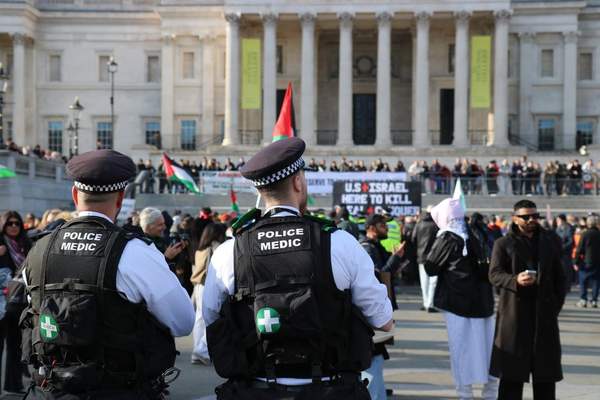
Article 11 protects peaceful gatherings, often alongside Article 10. Authorities can address genuine safety concerns and disruption, but restrictions need legal authority and justification. Protest law also contains specific offences and powers. Proportionality is not a universal defence to every protest charge; its relevance depends on the law and facts. Freedom of assembly law provides useful additional context.
A practical example: a town-centre protest
Imagine police expect a peaceful march through a busy shopping street. They identify a narrow junction where emergency vehicles must retain access. A targeted route adjustment, supported by evidence, may protect safety while preserving the march’s visibility. Banning the entire event merely because shoppers might be inconvenienced poses a harder proportionality question.
The meaningful comparison is between realistic options. What danger was identified? Was there evidence rather than speculation? Could stewards, timing changes or a revised route address it? How badly would an alternative undermine the protest’s message? These details matter more than simply calling the decision necessary.
What proportionality does not mean
Proportionality is not a mathematical formula, a promise that individual preferences always prevail, or permission for judges to make policy from scratch. Courts recognise that elected bodies and specialists may be better placed to assess complex risks. The weight given to their judgment varies with the context, evidence and right affected.
Nor does identifying a legitimate aim end the inquiry. An authority can pursue a proper objective but choose an unjustifiably harsh measure. Conversely, a gentler option does not automatically establish unlawfulness if it would substantially weaken achievement of that objective.
How to examine a possible interference
Identify the precise right and the decision affecting it. Find the legal power relied upon and the authority’s stated aim. Then examine its reasons, evidence and alternatives. Record practical effects: duration, scope, people affected and safeguards or routes to challenge.
Outcomes are fact-sensitive. Anyone considering proceedings should obtain advice promptly because legal routes and deadlines vary. Section 7 of the Human Rights Act contains rules on who may bring a claim, alongside other procedural requirements.
Frequently asked questions
What is proportionality in UK human rights law?
It assesses whether interference with a protected right is justified by examining its purpose, effectiveness, alternatives and impact. It is central to disputes about restrictions on qualified Convention rights.
How does proportionality differ from reasonableness?
Traditional reasonableness review often asks whether a decision falls outside an acceptable range. Proportionality more directly examines justification, less intrusive options and fair balance. The intensity of scrutiny depends on the case.
Can the government restrict freedom of speech?
Yes, within Article 10 and applicable domestic law. A restriction needs a legal basis, a permitted aim and a proportionate justification. An unpopular opinion alone does not justify interference.
Does proportionality apply to every human right?
No. Absolute rights cannot be restricted through balancing, while other rights contain specific limits. Always identify the relevant Convention article before applying the test.
Conclusion
Proportionality turns broad commitments to rights into questions about evidence, alternatives and consequences. In privacy, expression and protest disputes, the key is not whether an authority can name a worthwhile goal. It is whether the particular interference is legally justified and strikes a fair balance between the individual and the public interest.